
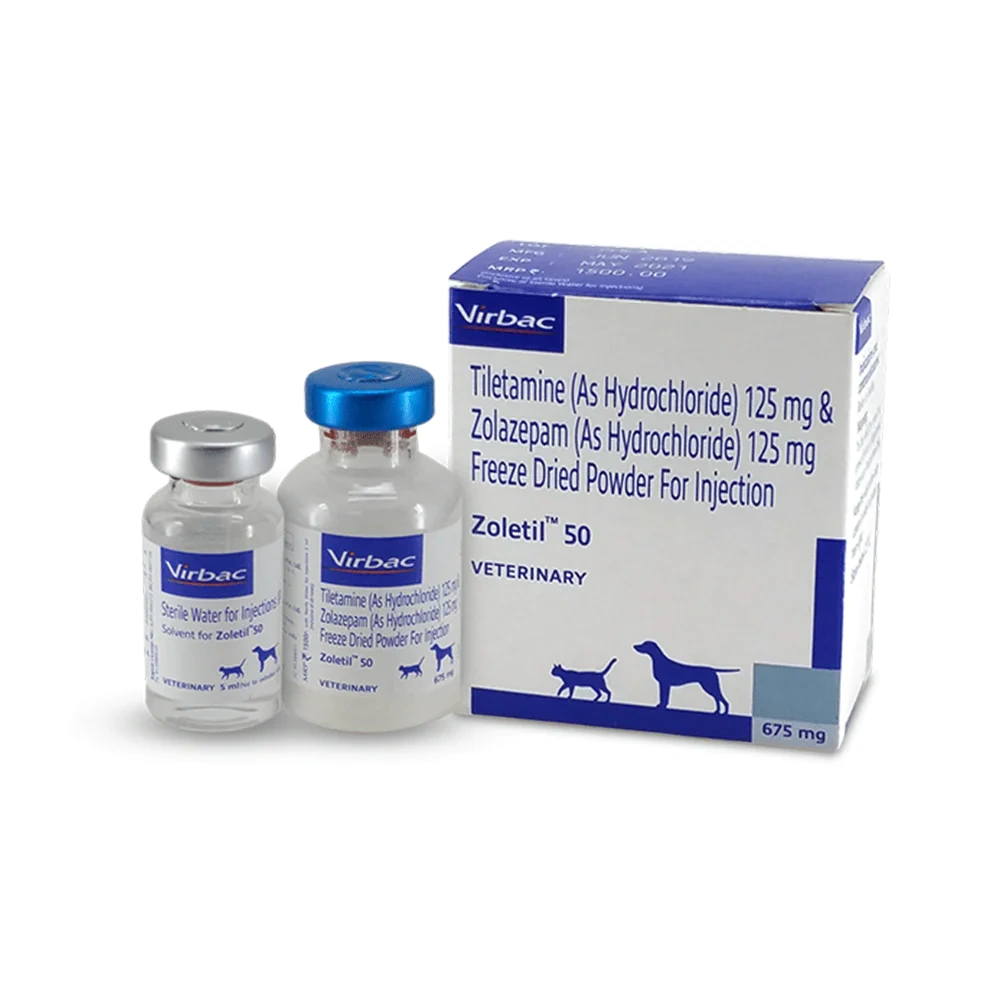

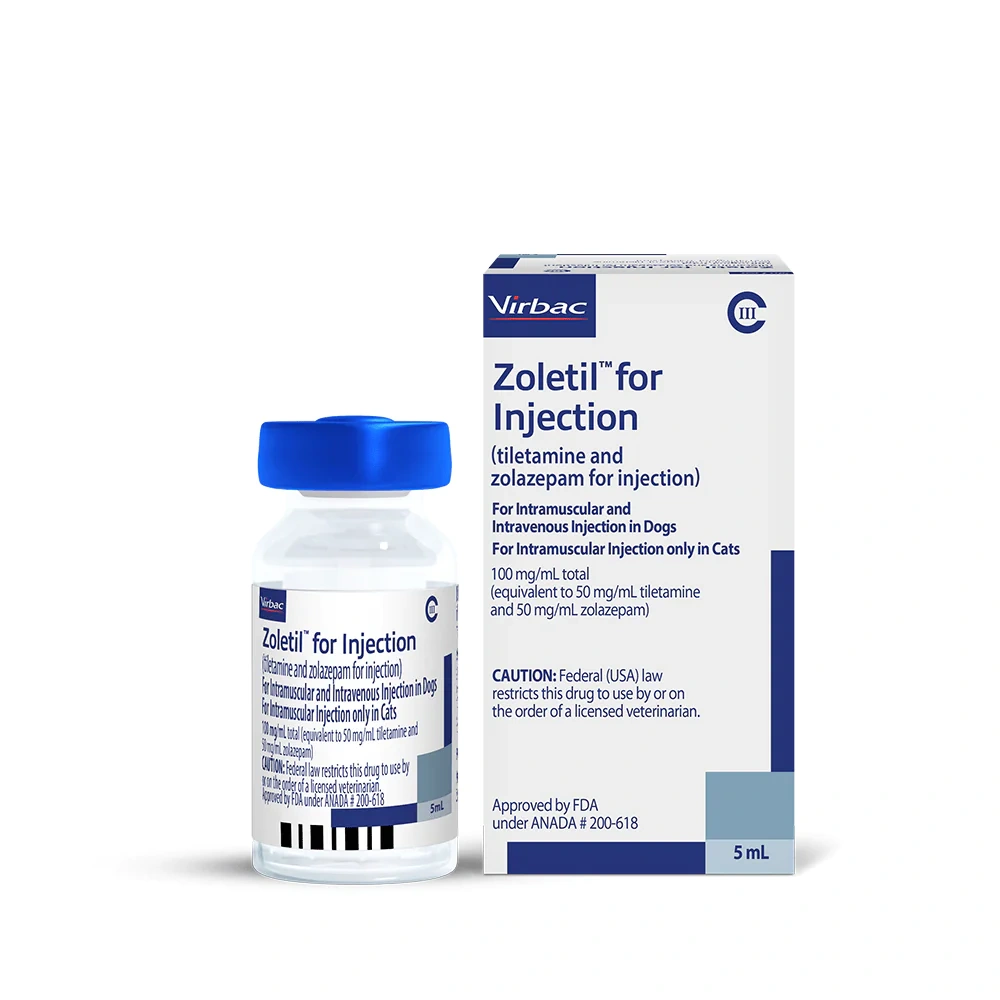

Virbac Zoletil Injection
₹1,500.00
- Sold by: MyAnimal Raipur
- COD available for orders between ₹800-₹4,000
- Free Delivery on orders ₹1,000 and above!
Zoletil™ comprises a synergistic balance between Tiletamine & Zolazepam. Tiletamine – a dissociative anesthetic. Zolazepam – a benzodiazepine tranquilizer group of drugs.
Recommended for
- As a sedative (for restraint, diagnostic, or painless examination procedures)
- As a sole anesthetic for minor surgeries or in combination with a potent analgesic for major surgeries
- As an induction agent, prior to inhalant anesthesia
With two proven ingredients, Zoletil™ is a smart option for general anesthesia combining sedation, muscle relaxation, and analgesia in dogs and cats. It offers peace of mind owing to its rapid onset of action, smooth recovery process, and wide safety margin. Zoletil™ provides the convenience of flexible dosing based on the procedure, multiple modes of administration (IV or IM), and the possibility to integrate into existing anesthetic protocols. With over 30 years of experience in small animal practice, Zoletil™ also demonstrates versatility and scientific recognition across numerous wildlife species.
Composition
Zoletil™ 500
| Formulation | Quantity |
| Tiletamine (as Hydrochloride) | 125 mg per vial (675 mg freeze-dried powder) |
| Zolazepam (as Hydrochloride) | 125 mg per vial |
| Excipients | qs |
| Sterile Water for Injection (5 ml vial) | 5 ml |
| Tiletamine (as Hydrochloride) per 1 ml reconstituted solution | 25 mg |
| Zolazepam (as Hydrochloride) per 1 ml reconstituted solution | 25 mg |
Zoletil™ 100
| Formulation | Quantity |
| Tiletamine (as Hydrochloride) | 250 mg per vial (970 mg freeze-dried powder) |
| Zolazepam (as Hydrochloride) | 250 mg per vial |
| Excipients | qs |
| Sterile Water for Injection (5 ml vial) | 5 ml |
| Tiletamine (as Hydrochloride) per 1 ml reconstituted solution | 50 mg |
| Zolazepam (as Hydrochloride) per 1 ml reconstituted solution | 50 mg |
Dosage and Direction for use
| In Dogs | Intramuscular route | Intravenous route |
| Tests and procedures causing little pain | 7 to 10 mg/kg BW | 5 mg/kg BW |
| Minor surgical procedures, anaesthesia of short duration | 10 to 15 mg/kg BW | 7.5 mg/kg BW |
| Painful intervention, major surgical procedures | 15 to 25 mg/kg BW | 10 mg/kg BW |
| In Cats | Intramuscular route | Intravenous route |
| Tests and procedures causing little pain | 10 mg/kg BW | 5 mg/kg BW |
| Surgeries | 15 mg/kg BW | 7.5 mg/kg BW |
Multiple administrations to be avoided and is associated with delayed recovery, but if given, re-administration should only be at 1/3 to ½ of the initial dose, but the total dosage is should not exceed 26.4 mg/kg.
Storage
- Prior to opening: Store in a cool and dry place, protected from light exposure.
- Post reconstitution: Store at 2 to 8°C and use within 24 hours.
Suggestions
- 12 hours of fasting prior to anesthesia
- Removal of anti-parasite collars 24 hours prior to anesthesia
- Anticholinergic drugs (such as Atropine) may be used 15 minutes prior to Zoletil™ administration
- Apneustic breathing may be observed in cats given IV; may last up to 15 minutes. Provide respiratory assistance if breathing does not return to normal.
- Eyes remain open and should be protected from excessive dryness; during major surgeries, a damp cloth can be placed over the eyes
- Animal should be placed in a calm environment during the recovery phase
Contraindications
- Cardiac disease or severe hypertension
- Respiratory disease
- Renal, pancreatic, and hepatic insufficiency
- Head trauma or intracranial tumors
- Caesarean section or in pregnant bitches and queens
- Use in conjunction with phenothiazine tranquilizers
Warnings
- For use in dogs and cats only.
- During anesthesia induction with Zoletil for Injection, patients must be continuously monitored. Facilities for airway maintenance, artificial ventilation, and oxygen supplementation should be available.
- Pulmonary edema has been reported in cats, with signs including dyspnea, lethargy, anorexia, and abnormal behavior. Deaths have occurred occasionally. Cats should be closely observed and treated appropriately if symptoms appear.
- Zoletil for Injection is primarily excreted in urine in cats; not recommended for cats with renal insufficiency.
- In dogs, balance studies show extensive biotransformation, with less than 4% of the dose excreted unchanged in urine.
- Zoletil for Injection is predominantly excreted by the kidneys; preexisting renal pathology may prolong anesthesia duration.
- Phenothiazine-derivative drugs should not be used with Zoletil for Injection at IM dosages, as the combination may cause respiratory and myocardial depression, hypotension, and hypothermia.
- Safe use in pregnant animals or for reproduction has not been established. Zoletil crosses the placental barrier and may cause respiratory depression in neonates.
Precautions
- The dosage of Zoletil for Injection should be reduced in:
- Geriatric dogs and cats
- Animals in debilitated condition
- Animals with impaired renal function
- Deaths have occurred in both cats and dogs following intramuscular administration of tiletamine and zolazepam; preexisting pulmonary or renal disease and shock may contribute.
- Intravenous tiletamine and zolazepam is safe in dogs when used with phenothiazine-derivative drugs (acepromazine) at 0.04–0.06 mg/kg IM.
- Cats and small dogs should be protected from heat loss during anesthesia; body temperature must be monitored and supplemental heat provided if needed.
- During anesthesia, athetoid movement may occur. This should not be mistaken for lack of anesthesia or analgesia. Additional dosing to stop movement can cause overdose.
- Zoletil for Injection does not abolish laryngeal, pharyngeal, pinnal, palpebral, and pedal reflexes, and may not be adequate as sole anesthetic for these areas. Endotracheal tubes may impair respiration in cats.
- Stimulation during surgical procedures helps maintain ventilation. Continuous monitoring is required to ensure adequate cardiopulmonary function.
- The eyes usually remain open with dilated pupils; use bland ophthalmic ointment to protect corneas.
- Concurrent use of chloramphenicol prolongs anesthesia in cats.
- Copious salivation may occur. Ptyalism can be controlled with atropine sulfate (0.02 mg/lb or 0.04 mg/kg IV, IM, or SC). Excessive swallowing or saliva may cause vomiting or retching.
Related products
-
 In Stock
 -
-

 Home
Home  Wishlist
  Checkout
  Account
  Dog
Dog Cat
Cat Cattle
 Poultry
 Goats & Sheeps
 Equine
 Fish
Fish Bird
Bird Pharmacy
Reviews
There are no reviews yet